Showing posts with label NASA. Show all posts

Thursday, January 3, 2019

Hats off to New Horizons

A few years ago, around the time of the New Horizons encounter with Pluto (or if you're really serious about the demotion thing, minor planet 134340 Pluto), I gave the team a bit of grief over the probe having to go into "safe mode" with only days left before the flyby, though I also tried to make clear that this was still engineering of a very high order.

Early on New Year's Day (US Eastern time), New Horizons flew by a Kuiper Belt object nicknamed Ultima Thule (two syllables in Thule: THOO-lay).  I'm posting to recognize the accomplishment, and this post will be grief-free.

The Ultima Thule encounter was much like the Pluto encounter with a few minor differences:
  • Ultima Thule is much smaller.  Its long axis is about 1-2% of Pluto's diameter
  • Ultima Thule is darker, reflecting about 10% of light that reaches, compared to around 50% for Pluto. Ultima Thule is about as dark as potting soil.  Pluto is more like old snow.
  • Ultima Thule is considerably further away (about 43 AU from the sun as opposed to about 33 AU for Pluto at the time of encounter -- an AU is the average distance from the Sun to the Earth)
  • New Horizons passed much closer to Ultima Thule than it did to Pluto (3,500 km vs. 12,500 km).  This requires more accurate navigation and to some extent increased the chances of a disastrous collision with either Ultima Thule or, more likely, something near it that there was no way to know about.  At 50,000 km/h, even a gravel-sized chunk would cause major if not fatal damage.
  • Because Ultima Thule is further away, radio signals take proportionally longer to travel between Earth and the probe, about six hours vs. about four hours.
  • Because Ultima Thule is much smaller, much darker and significantly further away, it's much harder to spot from Earth.  Before New Horizons, Pluto itself was basically a tiny dot, with a little bit of surface light/dark variation inferred by taking measurements as it rotated.  Ultima Thule was nothing more than a tinier dot, and a hard-to-spot dot at that.
  • We've had decades to work out exactly where Pluto's orbit goes and where its moons are.  Ultima Thule wasn't even discovered until after New Horizons was launched.  Until a couple of days ago we didn't even know whether it had moons, rings or an atmosphere (it appears to have none).  [Neither Pluto nor Ultima Thule is a stationary object, just to add that little additional degree of difficulty.  The Pluto flyby might be considered a bit more difficult in that respect, though.  Pluto's orbital speed at the time of the flyby was around 20,000 km/h, while Ultima Thule's is closer to 16,500 km/h.  I'd think this would mainly affect the calculations for rotating to keep the cameras pointed, so it probably doesn't make much practical difference.]
In both cases, New Horizons had to shift from pointing its radio antenna at Earth to pointing its cameras at the target.  As it passes by the target at around 50,000 km/h, it has to rotate to keep the cameras pointed correctly, while still out of contact with Earth (which is light-hours away in any case).  It then needs to rotate its antenna back toward Earth, "phone home" and start downloading data at around 1,000 bits per second.  Using a 15-watt transmitter slightly more powerful than a CB radio.  Since this is in space, rotating means firing small rockets attached to the probe in a precise sequence (there are also gyroscopes on New Horizons, but they're not useful for attitude changes).

So, a piece of cake, really.

Seriously, though, this is amazing engineering and it just gets more amazing the more you look at it.  The Pluto encounter was a major achievement, and this was significantly more difficult in nearly every possible way.

So far there don't seem to be any close-range images of Ultima Thule on the mission's web site (see, this post is actually about the web after all), but the team seems satisfied that the flyby went as planned and more detailed images will be forthcoming over the next 20 months or so.  As I write this, New Horizons is out of communication, behind the Sun from Earth's point of view for a few days, but downloads are set to resume after that.  [The images started coming in not long after this was posted, of course --D.H. Jul 2019]

Friday, August 21, 2015

Latency, bandwidth and Pluto

As you may well know, the New Horizons spacecraft flew by Pluto last month, dramatically increasing our knowledge of Pluto and its moons (let's not even get into whether Pluto and Charon jointly constitute a "binary dwarf planet" or whatever).  There are even a few pictures on the web.

But wait ... that's not very many pictures for a ten-year mission.  Even worse, if you were watching at the time you'll know that New Horizons went completely dark for most of a day, right when it was flying by Pluto.  Isn't this the modern web, where everything is available everywhere instantly?  What gives, NASA?

Part of the problem is the way New Horizons is designed.  It's expensive to accelerate mass to the speed New Horizons is going, and since you can't exactly send a repair crew out to Pluto, it's good to have as few moving parts as possible.  As a result, the ship has a small battery and both the antenna and the cameras are mounted firmly in place.  If you want to turn the antenna toward Earth, you have to move the whole ship, using some of the small store of remaining fuel dedicated to course corrections and attitude control.  If you want to point the cameras toward Pluto, you have to turn the ship that way.  You can't do both.

That explains why the ship went dark for the duration of the flyby, but actually it effectively went dark for considerably longer than that.  It takes about 4.5 hours for a signal to travel the distance between Earth and Pluto.  That means the sequence of events is, more or less
  • t + 0: Flight control sends commands to New Horizons to point the cameras at Pluto, take pictures, orient the antenna toward Earth, and report back.
  • t + 4.5 hours: New Horizons gets the command and starts re-orienting and taking pictures
  • t + 9 hours: Last time at which any signal from before the pointing operation will reach Earth
  • t + 25.5 hours (more or less): New horizons, now with the antenna pointed back toward earth, sends "Phone home" message reporting status.
  • t + 30 hours (more or less): "Phone home" message arrives
The important thing to note here is that, while the ship is actually out of contact for 21 hours, it's 25.5 hours from the time the command is sent to the time the ship is reachable again, and 30 hours before the ground crew knows it's reachable again.   If the phone home signal hadn't arrived, it would be 9 more hours, at a minimum, before they knew if any corrective action they'd taken had worked.  By internet standards this is ridiculously high latency, but anyone who's played a laggy video game or been on a conference call with people on the opposite side of the world has experienced the same problem on a smaller scale.

So part of the reason pictures have been slow in coming is latency.  It's going to take a minimum of 4.5 hours to beam anything back, and longer if the ground crew has to send instructions.

The other problem is bandwidth.  Pluto is about 5 billion kilometers (about 3 billion miles) away.  Signal strength drops off as the square of the distance, so, for example, a signal from Pluto is about 160 times weaker than a signal from Mars and, since the power source has to be small (around 15 watts), the signal is not going to be extremely powerful to start with.  Lower power means a lower signal to noise ratio and less bandwidth (or at least that's my dim software-engineer understanding of it -- in real life "bandwidth" doesn't exactly mean "how many bits you can transmit", and I'm sure there's lots more I'm glossing over).

Put all that together and on a good day we have about 2Kbps coming back from Pluto.  That's about what you could get out of a modem in the mid 1980s.   Internet technology has progressed just a bit since then, but internet technology doesn't have to cope with vast distances and stringent mass limitations.  At 2Kbps, one raw image from LORRI (the hi-res black-and-white camera) takes close to two hours to transmit.  This is why, if all goes well, we'll be getting Pluto pictures (and other data) well into 2016.

I'd still say that New Horizons is "on the web" in some meaningful sense, but the high latency and low bandwidth make it a great example of Deutsch's fallacies in action.

[Update: Not only is New Horizons sending back data slowly, it's not sending back particularly pretty data at the moment.  From their main page:
Why hasn’t this website included any new images from New Horizons since July? As planned, New Horizons itself is on a bit of a post-flyby break, currently sending back lower data-rate information collected by the energetic particle, solar wind and space dust instruments. It will resume sending flyby images and other data in early September.
-- D.H. 24 Aug 2015]

Saturday, November 30, 2013

"What was that bright light in the sky last night?"

While looking for information on comet ISON, I ran across an interesting project by NASA: the All Sky Fireball Network, a network of (currently) 12 black-and-white video cameras able to image the whole night sky.  The images from these cameras are processed by ASGARD (All Sky and Guided Automatic Realtime Detection), developed for a similar effort in Canada.  These astro folks sure love their acronyms.

A "fireball" is any meteor brighter than venus.  These are not rare events.  There are several on most nights, and nights with a dozen or two are not uncommon.   As there is deliberately quite a bit of overlap in the cameras' fields of view, most fireballs are caught on multiple cameras, making it possible to calculate the three-dimensional trajectory of the meteor, and from that determine its orbit.  Spaceweather.com posts a graphic of the night's calculated orbits.  I believe they produce that themselves from the raw data on the NASA site, which just seems to show the orbital elements as text.

It's pretty easy to see why this data is of interest to NASA.  Not only does it provide information about the composition of the Solar System, it's of practical use in designing satellites.  But even without that, it's a just plain neat hack.

Wednesday, November 20, 2013

Straight dope on Comet ISON

In a few days, a highly unusual comet will pass within a million miles or so of the Sun's surface.  That in itself is not unusual.   Comets pass that closely reasonably often and thousands such are known.  However, this comet is a "dynamically new" comet, meaning it has never been close to the Sun before, and no dynamically new comet has come so close to the Sun in at least 200 years.

This rare combination offers an unprecedented chance for astronomers to observe an object which has basically been sitting in a deep freeze since the formation of the Solar System react to close contact with the heat of the Sun.  That in turn will reveal much about what the comet is made of and thus offer clues about how the Solar System itself was formed.  Dozens of major observatories, on Earth and in space, will be watching.

As I write, the comet is visible to the naked eye in the pre-dawn sky, but only if you're in a dark place and know just where to look.  It's a little point of light, not your classic image of a comet.  At least not yet.

While ISON's orbit is known quite precisely, it's not at all clear what happens next.  On November 28th it will reach perihelion, its closest point to the Sun's center.  It will be moving at about 400 km/s, or about 900,000 mph, and experiencing intense heat and significant tidal stress that may or may not destroy it.  If it survives, it may reappear as anything from a point of light to a real spectacle.

If you've seen reports of a "comet of the century" likely to be "brighter than the full moon", this would be it.  The press has a habit of taking the "this could maybe happen if we're really lucky" scenario and running with it.  If you prefer to know what actual astronomers are saying and seeing and what the comet is up to, along with informative discussions of why we don't really know what the comet will do, you'll want to check out CIOC, NASA's Comet ISON Observing Campaign.

CIOC is a coordinating group.  It's not performing the actual observations, but it is a serious scientific collaboration, promoting research and gathering results for all the net.world to see.  This is classic Web, the kind of thing TimBL had in mind, I have to think, when putting up the first HTTP server way back when.

You may be wondering: What kind of a name is Comet ISON anyway?  It's named after the International Scientific Optical Network, a collection of 30 or so telescopes in about 20 countries that has been used in quite a bit of research, including but definitely not limited to detecting the comet in the subject line, formally known as C/2012 S1 (ISON).

UPDATE: Comet ISON appeared to disintegrate just before perihelion, and when it dropped behind the occluding discs of the SOHO (SOlar and Heliospheric Observatory) cameras that have been the main source of images for it in the past few days, the consensus was that there was a good chance that nothing would come out the other side.  When the SDO (Solar Dynamics Observatory) and PROBA (PRoject for On Board Autonomy) scopes that had been pointed at what should have been ISON's path failed to detect anything, the folks at CIOC did the only reasonable thing and declared it dead, vaporized in the heat of the sun (around 2800℃/5000℉).  And then it re-appeared.  At this writing, it is a fuzzy blob headed away from the sun, nowhere near as bright as it had been, but possibly bright enough to be seen with the naked eye when it gets far enough away from the sun.  We shall see.

UPDATE:  ... and it's gone.  On December 18th, the Hubble telescope was pointed at where Comet ISON ought to have been.  We can be quite sure of the location since anything solid remaining would have continued to follow the original orbit -- a solid object moving that fast is not going to be affected significantly by outgassing, the solar wind or other such effects.  The HubbleSite ISON blog has the full details, including photographs annotated to point out things you might think could be comet remains but definitely aren't.  Cosmic rays, stars streaking because the telescope is moving to follow the orbit of the comet, reflections on the lens and so forth.  Plenty of that, no comet.

Thursday, October 17, 2013

Welcome back, APOD!

A couple of days ago I went to NASA's Astronomy Picture of the Day (http://apod.nasa.gov/apod/) to catch up on goings-on in the sky.  The site wouldn't load.  Hmm ... is my network connection OK?  And then, I realized that I was trying to access NASA's site, at a pod.nasa.gov, and it was down because, well, the government was down.

Because I don't live under a rock, or at least not all the time, I already knew the federal government was (partially) shut down, and that even with only a partial shutdown, many people were experiencing effects a good deal worse than not being able to load a favorite web site.  What I'd forgotten -- despite the .gov in the URL -- was that APOD was run by a government agency.

That's probably partly because we don't notice URLs so much these days, which is a theme worth revisiting here one of these days, but it's also because a government web site just isn't that much different from any other.  My city's web site, and my school district's, the National Hurricane Center's, and APOD are just web sites, just as government officials from the federal level on down have social media accounts, home pages and so forth just like other people.

I don't think there's any profound lesson to be drawn there, just one of those things you notice every once in a while when the occasion arises.

Lessons or not, it's nice to see APOD again.


[Note: Because APOD is only hosted by NASA, the same content was available during the shutdown from various mirror sites]

Friday, September 7, 2012

Curiosity online

The Curiosity rover, formally the Mars Science Laboratory, landed on Mars late on August 5th (or early on the 6th, depending on your time zone).

This was a major accomplishment.  Mars has a habit of eating space probes.  The majority have failed, sometimes quietly and sometimes spectacularly, at least once due to the kind of basic coding error that would send a regular geek cursing back to the keyboard.  Except when it comes to interplanetary travel there's generally no "next release".

The Curiosity landing was more complex than any Mars landing before it, and parts of it had never been realistically tested, much less the overall sequence.  This was not out of negligence or cut corners but a simple necessity.  Mars's atmosphere is much, much thinner than Earth's.  At its thickest it's equivalent to Earth's atmosphere at about 35 kilometers (about 20 miles, or about four times as high as the summit of Mount Everest).  Mars's gravity is about 40% of Earth's.  There's simply no practical way to re-create those conditions at the necessary scale anywhere near Earth.

This thin atmosphere is a real problem.  There's just enough of it you can't ignore it, but not enough for a parachute to take the lander all the way to the surface safely.  To land Curiosity, which is considerably larger and more massive than the Spirit and Opportunity rovers before it, NASA put together a landing sequence that Rube Goldberg might have appreciated:
  • The probe slams into the atmosphere, protected by a heat shield and pulling upwards of 10g of deceleration, possibly as high as 15g (This is from NASA's press kit from before the landing.  I don't know what the actual numbers were, but clearly it's not going to work with humans aboard.)
  • Once the the probe has slowed enough not to need the heat shield, the heat shield is jettisoned.
  • The probe then deploys a parachute, which slows it to about 300 km/h (about 180 mph).
  • The parachute is then jettisoned and a rocket-powered descent stage takes over, carefully avoiding the parachute and the back shell it's attached to.  If the rockets don't work, the probe will hit the surface, hard, in about 20 more seconds.
  • The descent stage lowers the rover on nylon cords while it slowly descends, since landing completely under rocket power risks kicking up enough dust to damage the rover.
  • While the descent stage is doing this, the rover gets its landing gear into place.
  • When the rover is safely on the ground, the cords are cut loose, using explosives, and the descent stage flies off to crash land some distance away.
What could possibly go wrong?  Mind, this is a simplified description (and any inaccuracies are mine).  The full details include several more maneuvers, through six different configurations in all, with 76 pyrotechnic devices, ballast jettisoned at various points and dozens of people sweating bullets in the control room and elsewhere.

"Seven minutes of terror", they called it.  Damn impressive engineering, I call it.


OK, so now that we've paused to admire NASA/JPL's chops, what does this have to do with the web? 

I'm old enough to sorta kinda remember Apollo and grainy black-and-white TV coverage.  And Tang.  Cool, and, it must be said, more culturally significant than today's missions, but technically not even close to what we have today.  This is true not only of the vehicle itself, but of the communications technology.  In the 70s we had grainy black-and-white video.  For better imagery you had to wait for the astronauts to bring back the film.

Now, using essentially the same technology as a cell phone camera, NASA is able to capture digital images and put them up on its web site for the world to see immediately (as many have pointed out, much more quickly than NBC saw fit to broadcast Olympic events).  The web gallery includes not only the pretty press-release pictures but also the raw frames they were made from, including pictures of Curiosity staring at its feet and other such that didn't make the cut.  There are plenty of other goodies as well.  I particularly like the "white-balanced" images, which have been post-processed to show what the same terrain would look like under sunlight on Earth.

And there are, of course, a Twitter hashtag (#MSL) and (obligatory plug) updates on NASA's Google Plus page.

As inspiring as it may have been to watch thrilling news coverage with Walter Cronkite narrating, there's something much more intimate about being able to visit a web site from time to time and watch the story unfold directly from the source.

Tuesday, January 19, 2010

Will a solid rocket booster fit in my shopping cart?

Nearly forty years after its inception in 1972, NASA's space shuttle program is finally ending this year. That leaves the question of what to do with the million or so items of inventory that have accumulated over those decades. In today's web-enabled world, what else to do but put it all on line, eBay style?

Well, actually they're not putting everything online, or even close to it, at least not yet. And it's not open to the public, and you don't exactly bid on items. But, if you have a login, you can put requests for items in your shopping cart and if NASA selects you and you can defray the transportation costs, the item is yours.

If the item in question is an actual space shuttle, transportation costs will come to about $30 million. So far there are 20 or so applicants. Get while the gettin's good.

Thursday, September 24, 2009

Lost in a web of stars

The day job is less busy now. In the inevitable letdown period, my attention has wandered skyward, to the Astronomy Picture of the Day. Along with the Galaxy Zoo and other random sites, the APOD largely satisfies my desire to learn a little astronomy without, um, actually going out and looking at the sky. Besides, I learn more this way, or at least I learn things that just looking up at the sky gives little hint of. That's why they have all those telescopes and high-tech instruments, after all.

For example, while you'll often see pretty posters of the Orion nebulae or the Trifid nebula, it's another thing entirely to see them in context and realize that, were our eyes sufficiently sensitive (and our surroundings sufficiently dark) even a clear, dark sky would be cloudy. And of course, Van Gogh's Sterrennacht springs to mind.

In the night sky most places we see very little beyond local stars. In major cities it can be hard to see even that much. This limited view reveals very little about the universe at large. Recent theories hold that the universe was born out of some sort of quantum foam and still reflects that structure. What are they talking about? If you zoom out far enough, it starts to make sense.

How can astronomers develop theories of how stars and galaxies form when the timescales involved are much, much longer than anyone's lifetime? They look at lots and lots and lots of stars and galaxies. On a clear, dark night the unaided eye can pick out a few thousand stars. Galaxies have stars by the billion, and there are plenty of galaxies. The Hubble Deep Field, for example, covers about two millionths of the night sky and comprises about 3,000 galaxies. Even the Galaxy Zoo's original million are only a small sample of what's out there.

From common experience, stars (except our sun, of course) are little pinpricks of light. Science tells us that's because they're mind-bogglingly far away. Only objects in the solar system are close enough to appear as anything more than points [well ... you have the Sun, the Moon, the Andromeda galaxy, the Magellanic clouds and the occasional comet ... but let's just agree that you'll see a lot more with a telescope, especially a big one or one in space --D.H. Dec 2015]. But with a good telescope, you can not only tell stars from points of light, you can not only see that stars are round, you can see one that isn't and pick out individual stars in a galaxy far, far away (well, actually a pretty close one by galactic standards).

With special equipment astronomers can see colors the eye can't, as in this lovely image of the Andromeda galaxy in ultraviolet (make sure your cursor isn't over the picture), or pick out otherwise hidden features and reveal the complexity of the processes at work in a nebula, or even show us what's right in front of our faces.

This is a really small sample of the APOD archive. Wander through it yourself and you'll find all kinds of wonders and not a few oddities. But beyond the pretty pictures, the real value lies in the descriptions, written by professional astronomers. It's one thing to read in a science article about this or that theory or process, quite another to see a principle illustrated by a real live picture from a real live observatory accompanied by a clear, concise paragraph rich in links to further pictures and other resources.

This is the kind of thing the web was made for. Certainly it's long been possible to subscribe to an astronomy magazine or go to the local library and get information of a similar quality, but the web enhances the experience considerably.

Tuesday, November 18, 2008

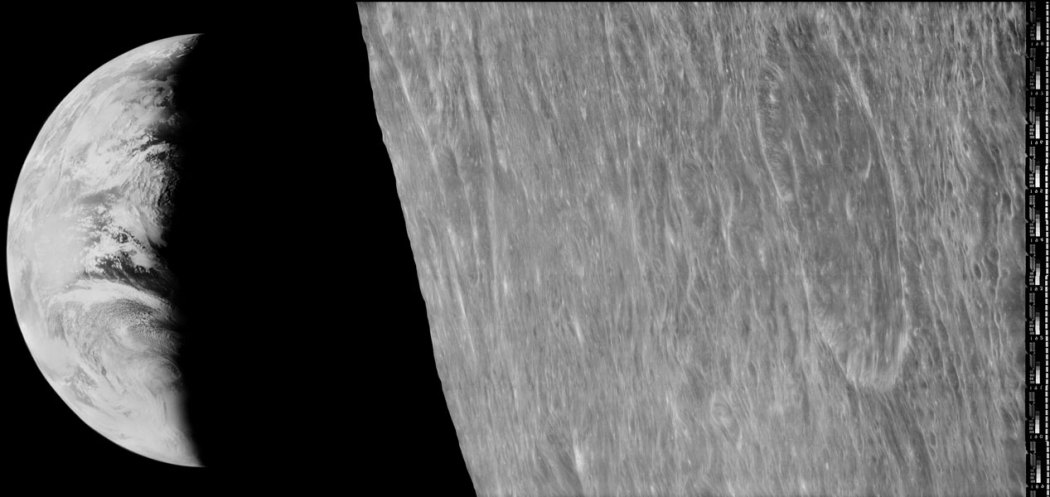
Old-school image processing, or Moon pictures remastered

Before anyone set foot on the moon, it was considered important to survey the place. To this end, NASA sent probes fitted with cameras and the ability to beam back pictures. There being no CCDs at the time, the probes actually used film, developed it and scanned the resulting prints for transmission. The transmissions were recorded on magnetic tape as a backup, thanks to the foresight and efforts of Charles J. Byrne; the preferred mode of storage was to print the pictures and store the prints. What most of us saw the first time around, including the famous Earthrise image, was actually third-generation material: reproductions of photos of those prints. [Or fourth-generation if you count the original film up in space.]

Twenty or so years later, Planetary Data System co-founder Nancy Evans, then at JPL, took the tapes into her care and started a project with Mark Nelson to find and refurbish tape drives that could read the old tapes. The project stalled for lack of funds. Evans retired from JPL to become a veterinarian and stored the tape drives in her garage.

Another twenty or so years later, Evans retired as a veterinarian and went looking for someone to take the drives off her hands and, hopefully, put them to their intended use. Dennis Wingo and Keith Cowing took on the job, moved the drives into a disused McDonalds in NASA Ames' research park and set to getting them working again. This involved a lot of cleaning, swapping of parts and working with circuits whose components were actually large enough to see and handle. It took them 99 days, but they got the thing working.

Even better, the results are now on the web, as is the more complete account I'm summarizing.

The web has acquired another significant chunk of history -- the digital images the probes would have sent back if they could have, and if there had been any place to put them.

Most definitely a neat hack.